
What is Force?
You don't find this clear explanation in any college science book

From The Neglected Facts of Science by Dewey B. Larson:
For application in physics, force is defined by Newton's Second Law of Motion. It is the product of mass and acceleration, F = ma.
Motion, the relation of space to time, is measured:
on an individual mass unit basis as speed, or velocity, v, (that is, each unit moves at this speed), or
on a collective basis as momentum, the product of mass and velocity, mv, formerly called by the more descriptive name "quantity of motion."
The time rate of change of the magnitude of this motion is then:
dv/dt (acceleration, a) in the case of the individual unit, and
m dv/dt (force, ma) when measured collectively.
Thus force is, in effect, defined as the rate of change of the magnitude of the total motion. It can legitimately be called "quantity of acceleration" and this term will be used in the following discussion where it is appropriate.
You don't find this clear explanation in any college science book.
Notice how simple it is now:
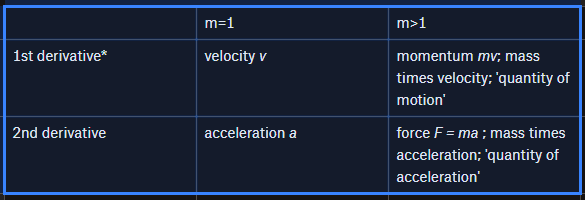
* Traditionally, velocity is the first derivative of position, however it is important to note that in a Universe of Motion, position is merely the resultant 'snapshot' of motion when framed in spatial geometry, but this distance or interval has no objective reality. Position is an artifact of imposing this subjective construct of space on the objective reality of motion.
In Larson's concept where motion is fundamental, it would perhaps be more accurate to refer to position as the integration of velocity (or its 'inverse derivative') and hence, acceleration and force would be re-framed as the first derivatives of velocity and momentum, respectively. But conventional physics is so hopelessly confused with its arbitrary units and ad-hoc forces (and other imaginary quantities) that this change in notation would be quite difficult to accept.
Force is a property of motion
Back to Larson:
It follows from the definition that force is a property of a motion; it is not something that can exist as an autonomous entity. It has the same standing as any other property. The so-called "fundamental forces of nature," the presumably autonomous forces that are currently being called upon to explain the origin of the basic physical phenomena, are necessarily properties of underlying motions; they cannot exist as independent entities. Every "fundamental force" must originate from a fundamental motion. This is a logical requirement of the definition of force, and it is true regardless of the physical theory in whose context the situation is viewed.
In the absence of an understanding of the nature and properties of distributed scalar motion, however, it has not been possible to reconcile what is known about the "fundamental forces" with the requirements of the definition of force, and as a result this definition has become one of the disregarded features of physics, so far as its application to the origin of the forces is concerned. Notwithstanding the fact that force is specifically defined as a property of motion, the prevailing tendency is to treat it as an autonomous entity, existing prior to motion. The following statements, taken from current physics literature, are typical:
"So forces provide structure, motion, and change of structure."
"The gravitational force, the electric force, and the nuclear force govern all that happens in the world."
"The electric force is perhaps the fundamental conception of modern physics."
"As far as anyone knows at present, all events that take place in the universe are governed by four fundamental types of forces."
It is commonly recognized that the usual significance attached to the concept of force is in some way incomplete. Richard Feynman's view is that force is something more than the defined quantity. "One of the most important characteristics of force is that it has a material origin," he says, and he emphasizes that "this is not just a definition." Further elaborating, he adds that "in dealing with force, the tacit assumption is always made that the force is equal to zero unless some physical body is present." This is unacceptable in an "exact" science. If a definition is incomplete, it should be completed. But, in reality, the definition is not incomplete. The prevailing impression that there is something missing is a consequence of the refusal to recognize that this definition makes force a property of motion.
The status of motion as the basic entity is the reason for the "material origin" that Feynman emphasizes. Without the presence of a "physical body" there is no effective motion, and consequently, no force.
In other words, the so-called fundamental nuclear forces - even the ‘force’ of gravity, are simply artifacts of ignorance. These are merely the secondary effects of the interaction of particular motions of matter.
https://godparticle.substack.com/p/what-is-time
https://godparticle.substack.com/p/si-to-spacetime-units