
What is Time?
"Everything got to where it is by motion. Space is the history of motion."

Neither time, nor space, have independent existence; they are merely mathematical abstractions, two reciprocal aspects of motion. That is to say, space and time are geometric inverses of one another. The fundamental motion of the universe is to simultaneously expand and contract; we see the scalar progression in space as the recession of the galaxies in all directions and we see the contraction of space as gravitation from all directions; we cannot observe the expansion of time as the progression of an inverse space, yet we detect its existence as antimatter and cosmic radiation.
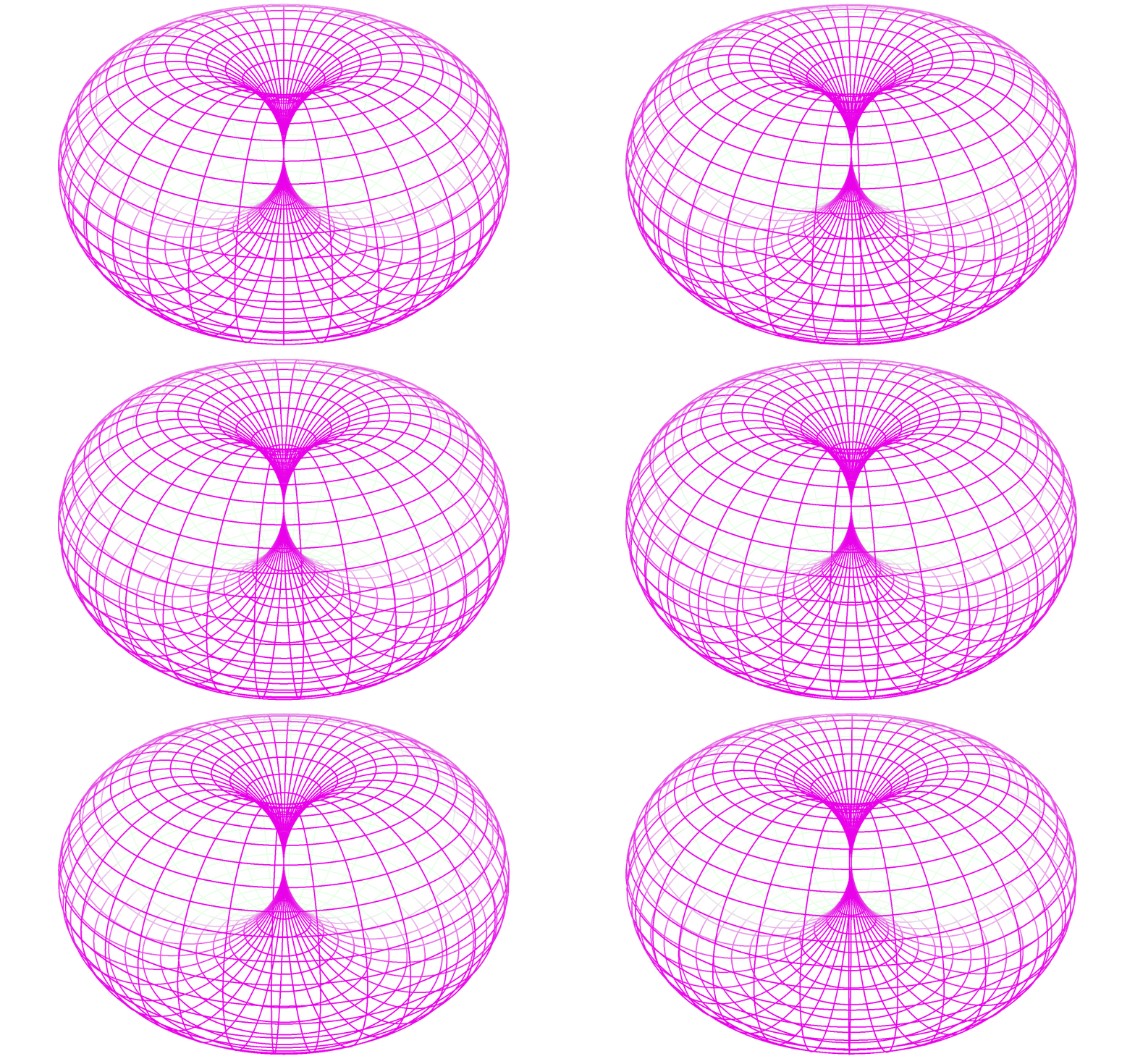
As explained in Glipses of a New Paradigm (KVK Nehru):
At the unit level, not only is one unit of space like all other units of space, but a unit of space is equivalent to a unit of time. Larson postulates a total uniformity in the properties of space and of time, except for the fact that they are reciprocal aspects of motion. Thus he concludes that time, like space, is three-dimensional, and that space, like time, progresses. "
The question still remains how to describe a "fundamental motion" according to the claim that "neither time, nor space, have independent existence; they are merely mathematical abstractions, two reciprocal aspects of motion" How can we define "motion" when "neither time, nor space, have independent existence" but are to be defined by MOTION?
We describe space as 3-dimensional, and from the fundamental postulates, this obviously remains. But three dimensions is not a property of space, it is a property of motion. We know instinctively that distance is perceived as a thing is moved from one location to another; likewise we perceive a displacement of time as we notice dripping raindrops or the turn of a clock's hand. This is simply "change." But we calculate velocity as a change of space per change of time, in *arbitrary* units of space and time : km/h, meters/sec, or c, the speed of light.
We observe that light naturally moves outward in all directions - in three dimensions. Astronomers observe that distant galaxies all naturally move away from each other in all directions (there is no central origin), and that massive bodies that are not so distant (as are galaxies) move toward each other from all directions. So to be clear, it is two things moving away from each other that makes distance (linear) and the interval over which the motion is observed makes time. And it is three things moving away (in relation) that makes space (three dimensions).
"Everything got to where it is by motion. Space is the history of motion."
Now mathematically we know from fundamentals like conservation of unit and conservation of dimension, that speed = distance / time ; v=s/t ; it is evident that since the quantity of motion involves three dimensions, and that space and time are reciprocal in relation to one another, both must be three dimensional. (For, geometrically, a plane divided by a line defines two half-planes, and their intersection is a line ; a space divided by a plane defines two half-spaces; their intersection is only a plane). Likewise, since time naturally progresses, space also naturally progresses. We perceive time as a scalar progression (without direction in space but always "forward") because we are physical beings but we must apply reason to surmise that it is a 3-dimensional quantity.
Space and time are aspects of motion by definition, just as a radius is an aspect of a circle. That is not to say that the hypotenuse of a square or radius of a circular orbit physically exists nor is it to say that the radius of a quark is physically, infinitely divisible, these have a natural limit in being quantized. We may reason about a radius smaller than that of a quark but it is only mathematically defined, not a physically real entity.
Using the fundamental relation of space to time, motion, v=s/t :
Scalar progression: 1/1, 2/1, 3/1, 4/1…
Scalar contraction: 1/1, 1/2, 1/3, 1/4…
Simultaneous scalar progression/contraction ("rest" in the natural frame of reference): 1/1, 2/2, 3/3, 4/4…
The fundamental motion in the universe is the scalar progression of space in relation to time: if we write it mathematically as s/t, 1:1, we say 2:2 ; 3:3 ... are equivalent speeds. Only by deviating from unity is there a motion differentiable from it: 1:2 is half as fast ; 2:1 is twice as fast.
Now, a deviation from the natural progression of space:time can be in any combination of one, two, or three dimensions (the latter two being compounds of the first). The simplest deviation is one-dimensional ; a linear translation from locus A to B (with respect to the natural progression) may be said to be the simplest. A linear motion only is attributed 'direction' when we assign an arbitrary frame of reference in relation to a third locus, C (defining a two-dimensional space), and this we call a vector. Similarly, rotation about a one-dimensional axis - only in relation to a second point as a frame of reference, again, defining a plane. A linear vibration involves a cyclical reversal of direction, and analogously, a rotation, being cyclical, can be said to be a vibration, depending on how many dimensions are considered in the frame of reference. A composite of two linear vibrations together defines a circular motion, also a rotation. A composite of circular motion with a linear motion defines a spiral. A composite of two rotations defines precession - and so on... all depending on what frame of reference is chosen. Imposing another object or coordinate system as a frame of reference introduces dimensions not necessarily inherent in the motion, or excludes them.
Space and time do not compose motion; motion 'defines' space and time as a change of distance per change of time, and these two are geometric abstractions, mental tools no more physically real than pi or dollars.
Space and time are not independent of motion, but quite the contrary, they are defined by motion. That is why space and time have no independent existence, and in fact they are only mental abstractions.
The Universe of Motion reminds me how once a martial arts master explained to me that "all things are always moving" - and we know this to be true from microscopic to macroscopic, and even Einstein declared that there is no absolute rest - all motion being relative. I like the way Terence McKenna said it (paraphrasing William Blake):
"Nothing lasts, but nothing is lost ; everything is changing into something else."
https://godparticle.substack.com/p/si-to-spacetime-units
https://godparticle.substack.com/p/what-is-force